Would you like to find yourself in shamballa???
If yes, click on one of the links below, and start your journey!
As it is required at the Arts Management Faculty (IBS, Budapest) I left some comments about my photography, drawing, sculpting and web design lessons. This semester I added 'create an exhibition' and 'music/video production' sections.

Don't forget to look through the older posts!

..On your right is a list of some links, so you could listen to the music you like while reading ... There are some interesting videos as well!!!


AND NOW:

CHOOSE, THEN CLICK:


Monday, December 13, 2010

Video & Architecture

Today we are able to manage, organize, control and shape our environment as never before.
From complex designs and lighting towards mixed outlines of human perception, the world we live in has become a unique setting of personal desires.
Now we can create any artistic endeavor from our imagination’s impulsions, this becoming more and more an instant achievable ambition.
Video projection has approached the top of its extended way. The flat, white screens became already a last decade reality. At this moment, a video can be projected onto almost anything, letting us to be the holders of our own creativity. One of the mediums that has become an increasingly trendy place to put large scale images, is on buildings. This started out as a merely artistic challenge, but has progressively moved into the realm of entertainment and advertising.
What is proving to be nowadays one of the most useful, fashionable and successful technologies, is 3D animations projected onto external spaces. Buildings are the largest canvases on which artists can paint; painting in this case changing its direct meaning into creating and visualizing the artist’s dreams, being part of a real life environment.


Video Projection on buildings revolutionizes how the world engages with ideas and information. It became a captivating and innovative way of communication. Whoever is looking for an impressive, gorgeous, eye catching way of assigning a message (advertisement) should get familiar with a new phenomenon, called 3D Projection on Buildings.
Different companies develop and create trendy, digital animations through special developed technologies that can be projected onto a building of any size. They offer services worldwide, giving the customer a unique opportunity to create an exceptional product, fully adapting to the architecture of a building or facade. Distinguishing elements of a (monumental) building will be used to create extraordinary effects. Due to the huge format of the projection (no limitations for size) as well as the 3 dimensional visual effects, a very imposing experience can be created. This renewed application of a remarkable format, attracts a lot of attention, which can be directed towards different events like openings, product launches, festivals, etc. This trend is becoming the leading way to bring brand advertising campaigns to life.
If talking about the technological side of this marvelous invention, it is certainly necessary to use more than one projector in order to get a crisp, complete projection of a building and not only parts of it. Furthermore, it would be nice to have a generic content of the projection, in order that the video can interact with the architecture dynamically.

If video projectors are arranged in different positions, the projected image on the target (in that case the building) will be distorted. So, it will be essential to distort the image by applying a transformation to it.
In conclusion, I may say that Projection on Buildings is bringing constructions to life of some new levels. It gives impression of a breathing creature, an astonishing virtual and at the same time real production that is definitely inspiring. It presents a new image scale for architecture, which can be changed and shaped accordingly. Predicting the future way of entertainment, 3D Projections on buildings will change the way we look at structural designing. And it will not only be about amusement and distraction, but also about advertising, tourism and branding…

Johnny Chung Lee did: 555 KUBIK | façade projection

APPENDIX
Some of the Top 5 Amazing Videos projected on buildings

Branchage Film Festival 2009
“Using cutting edge 3D Projection mapping techniques the Castle will be showered in light. At first seeming to simply illuminate, morphing over time as the entire architectural form of the castle distorts and morphs. Objects pour out the windows, the walls unravel and energy builds as this logic-defying spectacle captivates and questions your perception. This battle of light and the senses will expose the castle like never before!”
NordCom in Germany
“Pinwall: Facade becomes an interactive gaming board”
Samsung in Amsterdam
“In order to enforce the launching of the new Samsung 3D TV, NuFormer Projections developed an impressive 3D projection on the façade of the Beurs van Berlage in Amsterdam. The projection was implemented on May 20 and lasted till May 22, 2010. Spectators were able to view the projection during these nights. Within one day quite a number of recordings were put on sites/portals such as Youtube and other news sites.”
BMW in Singapore
“This particular 3D projection was done on two identical, adjacent buildings of Sun Tec City in Singapore. The projections were quite large and fitted with matching audio. The entire projection consisted of 3D animation, based on the style and video footage of the latest BMW TV commercials. The projections were implemented on two nights and were part of a special event for the top executives of BMW Asia and their business associates.”
New Year’s Eve in Texas
“3D Projection mapping in the city of Sugarland, Texas for the 25th anniversary of the city.”

REFERENCES

Beautiful 3D Building Projection, n.d., accessed December13, 2010
http://www.buzzfeed.com/sayomg/beautiful-3d-building-projection-tah


3D projections on buildings, n.d., accessed December13, 2010
http://www.projectiononbuildings.com/


Guerilla Video Projection- Engage Audiences with Outdoor Building Video Projection Advertising, n.d., accessed December13, 2010
http://www.altterrain.com/light_projection_advertising.htm


Mark Frauenfelder, Jul24, 2009, Trompe-l’oeil video projection on building façade, accessed December12, 2010
http://boingboing.net/2009/07/24/trompe-loeil-video-p.html


John Boese, June18, 2010, Video Projection: When Buildings come to Life, accessed December12, 2010
http://nydigitallab.ogilvy.com/2010/06/18/video-projection-when-buildings-come-to-life/


Adobe, January15, 2009, Trippy, amazing video projection onto buildings, accessed December13, 2010
http://prsync.com/adobe/trippy-amazing-video-projection-onto-buildings-16395/

Sunday, November 21, 2010

Done, Done, Done!

Finally, after so much running, after so many problems and after so many headaches - IT IS DONE!
Let me remind you step by step what was the purpose of this project:
1. The installation had to be part of a bigger project, which was about DONATING gifts for poor kids. It was organized by our class as well.
2. We had to create an installation that would inspire the viewers to donate gifts.
3. The installation was thought to be interactive, creating an intimate connection with the viewer.

Installation description:

A big black box (created from the base of a shelf and a carton hand-made box as a cover of the top-part and a screen in it). So, the carcase was black. The only 2 things coming out of it were a screen and red hands in "pray" position.
On the screen, one could see shots of children's faces; but only eyes or lips, which transmit a sad message.
The hands under the screen were constructed as follows:
a) metal wire was folded in form of hands
b) we got red gloves, in which we arranged the formed wire and filled them with sponge, in order to create a feeling of real kids' hands
c)in one of the gloves we put a mouse, so that when we would touch the hand, we would touch the mousse button as well
d) we inserted the hands into the black carton cover and sticked it to the shelf.

Now, after all the materials were ready, and the installation almost done, the video had to be made. And we used PowerPoint.
Just as always, the most genial ides are- SIMPLE ideas. It was easy to arrange it, but till we got to the ppt arrangement, we brainstormed a lot.

So, the viewer sees a huge black box with a screen in it. On the screen he sees parts of children's sad faces. Under the screen there are kid's hands in "pray" position. When you grab the hands, you click at the same time on the mousse and suddenly the sad shots transform into happy ones.

DONE with the INSTALLATION!


Wednesday, November 10, 2010

Saturday, October 23, 2010

Video installation

here is our next task.
we have to prepare a video installation.
purpose: to attract people to give presents for children at St. Nicolay's day.
image: a screen where different parts of a SAD kid's face can be seen(eyes, lips,etc).
under it - small hands in "pray" position made from plastic or clay where a button is.
process: the visitor sees the sad parts of a child's face on the screen. As soon as he touches the plastic hands, he pushes the button at the same time and suddenly the sad mimics transform into smiling ones.
idea: it is to show that a simple interaction can make one kid happy: A touch/ that in our case will symbolize a present.

soon, i will upload the detailed sketches of the project.

Sunday, October 17, 2010

TANGO - Zbig Rybczynski 1980 - Intrattenimento

http://vodpod.com/watch/3066585-tango-zbig-rybczynski-1980-intrattenimento-libero-video

Tango is a short film by Zbigniew Rybczynski. There is a static shot of a single room and over the 8-minute span of the film, 36 different characters enter the room at different times and perform a specific action. Each character never acknowledges the presence of the other characters.

Tango won an Oscar for Best Animated Short Film in 1983. Rybczynski talks about the project on his website:

Thirty-six characters from different stages of life – representations of different times – interact in one room, moving in loops, observed by a static camera. I had to draw and paint about 16.000 cell-mattes, and make several hundred thousand exposures on an optical printer. It took a full seven months, sixteen hours per day, to make the piece. The miracle is that the negative got through the process with only minor damage, and I made less than one hundred mathematical mistakes out of several hundred thousand possibilities. In the final result, there are plenty of flaws ® black lines are visible around humans, jitters caused by the instability of film material resulting from film perforation and elasticity of celluloid, changes of colour caused by the fluctuation in colour temperature of the projector bulb and, inevitably, dirt, grain and scratches.

Watch this funny video!
And not only the video is funny, the story afterwards too:

At the 1983 Oscar ceremony, Polish director Zbigniew Rybczynski had possibly the worst night that any Oscar winner has ever had at the Academy Awards. When his short film, Tango (1981), was announced as the winner of the Best Animated Short category, presenter Kristy McNichol mispronounced Rybczynski's name as "Zbigniewski Sky." When Rybczynski accepted the award, his speech was cut off by the orchestra. After talking to reporters in the press room, Rybczynski stepped outside the auditorium to have a cigarette. When he tried to return, an overzealous security guard refused to let him in. Rybczynski was holding his Oscar, but was dressed in a cheap suit and sneakers because he had been unable to afford better clothes. He tried to explain to the guard that he was an Oscar winner, but his English was limited. Hearing Rybczynski's Polish speech, the security guard assumed the director was drunk and shoved him up against a wall. During the altercation, Rybczynski reportedly yelled, "American Pig! I have Oscar!" and tried to kick the guard in the groin. Rybczynski spent the night in jail before the mess was sorted out.

TANGO - Rybczynski

"In Tango, exploits this concept of the single offscreen space by filling it with a plethora of actions. It soon becomes obvious that such a small space, that of a small room, could not possibly contain all the actions taking place. Rybczynski also makes critical use of off-screen space, exposing it for the artifice it is. Off-screen space is the imaginary area beyond the edge of the screen, and in front of or behind the camera. There are a number of ways through to off-screen space in Tango - a window and a door in the back wall, doors on either side of the room, and cupboard which also has its uses. Rybczynski orchestrates his entrances and exits with great precision.”

- Roger Noake, Animation Techniques, Secaucus, Chartwell Books Inc., 1988.

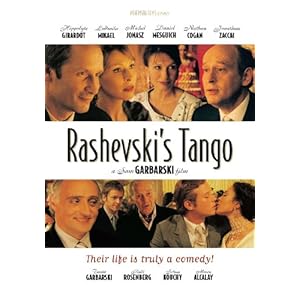
The tango Rashevski

Le Tango des Rashevski
Belgian-Luxembourg-French romantic drama, 90 min, 2003
A nice, liberal Jewish family in the everyday life of chaotic and non-everyday Belgium. Woody Allen's European style, the composer of the music of Mood for Love.
Director:
Sam Garbarski

Adolphe 'Dolfo' Rashevski travels to Israel with grandson Ric, but his brother, orthodox rabbi Samuel 'Shmouel, refuses to come attend their fellow Auschwitz survivor sister Rosa's funeral. Back in their home, the whole well-integrated family and their 'gojim' (non-Jewish and would-be) partners regularly wrestle with the meaning of Jewish blood, traditions and religion. For one it seems the way to gain a wife, for others the bomb under or the obstacle for a marriage. Yet love tends to conquer all but death. Written by KGF Vissers

Synopsis:
Director Sam Garbarski marked his feature film directorial debut in 2003 with the family-comedy drama Le Tango des Rashevski (The Rashevski Tango), a tale of one extended family's struggle to find meaning and identity within their own somewhat dormant Jewish heritage. When 81-year-old family matriarch Rosa Rashevski passes away, her descendants are left unprepared, as they have no idea what traditional Jewish rites they should be practicing. As a result, various Rashevski begin some rather intense periods of spiritual introspection, ranging from Rosa's granddaughter Nina's (Tania Gabarski, daughter of the director) proclamation to start and raise a Jewish family to grandson -- and former Israeli military man -- Rica's (Rudi Rosenberg) turbulent relationship with his Muslim girlfriend, Khadija (Selma Kouchy). To further complicate matters, a non-Jewish family friend named Antoine (Hippolyte Girardot) shows up at the funeral and strikes up a conversation with Nina, whom he used to baby-sit when they were both younger. As he grows more fond of the young woman and becomes intent on making her his wife, he learns of her intentions to have a Jewish family and tries to find a solution that would make the young woman reconsider him as a suitor.

~ Ryan Shriver, All Movie Guide

Saturday, October 16, 2010

Video-Film--> Differences

Video:
- B cathegory
- Feeling real
- Has a closer relation to the viewer (family relations)
- people involved are non professional
- usually these are family members/friends
- it s about every day life
- shorter
- it's moving/shaking hands
- the subject matter/ day by day events
- the jumps between the scenes

Film:
- A category
- expensive
- need for the scenery
- professional
- special effects
- actors
- fantastic/fiction
- memorable, makes interested everyone
- longer
- smoothly captured

Basic differences between video and film - as we see it.
02/18/2005
Q: "So why does video tape look different than film?"

A: Whether analog or digital, videotape will probably always appear different from traditional color film. Many people still hold to the notion that video is "inferior" to film. But one of the most important reasons for the difference may surprise you.

Color video - and for convenience we'll talk about the standard NTSC format used in the US - actually duplicates the way our eyes see much more accurately than most color film formats. A video camera captures RGB (Red/Green/Blue) information, essentially using three cameras in one: one sensitive to red light, another to green light and a third to blue light. This is very close to the way our eyes see. We also have cells that are sensitive to light - luminance - in general. Video also captures luminance information, which it combines with the color information. So what we see on video very closely resembles our own experience of vision. Digital video cameras work the same way but convert the image information into binary data for storage.

In most film, by contrast, the light is being captured to four photosensitive layers called CMYK. One layer is for the Cyan (blueish-green, to us) colored contents, one for the Magenta (a hot pink), and one for Yellow. The fourth layer (K) records light strength in general. Actually, in most film processes the three "color" layers are originally black and white; the appropriate color dyes are applied during processing. Part of the charm of film reproduction lies in the fact there's a certain degree of error - not all colors are reproduced and are therefore shifted. The overall result is what we perceive as "warmer." Sound familiar, analog audio freaks? We're so accustomed to seeing these colors - and film directors and cinematographers have so creatively manipulated them - that we rarely notice the difference. There are actually several color film process technologies including the best known, Technicolor (which hasn't been used in America for many years).

Another difference is found in the frame rates of the two mediums. Almost all film is recorded as 24 still pictures per second. Each still picture was captured in one shot just like an ordinary still camera works. In video reproduction there are 30 (approximately) still pictures playing back per second. Each of these pictures was created by scanning the source from top to bottom and from left to right. Although both frame rates suitably create the illusion of motion, our eyes pick up tiny "cues" that our brain receives and translates as film or video, based on our experience of both.

There are changes coming, however. One is the adoption of the 24P frame rate for digital (and high definition) video, plus progressive scan playback, both of which more closely approximate film. Additionally, 10-bit RGB values (coming to a megaplex near you in Star Wars Episode III) allow finer distinction between hues. Though it is theoretically possible for digital video technology to completely emulate the quality that film provides it isn't yet practical to try to do so. Further, the various distinctions between film stock and processing methods makes the specific goal of what, exactly, one would be shooting for not very well defined - very similar to the analog versus digital audio debates.

Friday, October 15, 2010

DOGMA FILMS

What is actually a DOGMA FILM?

Let s start with the definition of it. It s a doctrine relating to matters such as morality and faith.
It's a principle, belief, or statement of ideas or opinion, especially one considered to be absolutely true. For instance, the dogmas of the quiet past are inadequate to the stormy present.
Related to that, here is what I have read:

Dogme 95 is an avant-garde filmmaking movement started in 1995 by the Danish directors Lars von Trier and Thomas Vinterberg, who created the "Dogme 95 Manifesto" and the "Vow of Chastity". These were rules to create filmmaking based on the traditional values of story, acting and theme, and excluding the use of elaborate special effects or technology.[1] They were later joined by fellow Danish directors Kristian Levring and Søren Kragh-Jacobsen, forming the Dogme 95 Collective or the Dogme Brethren. Dogme is the Danish word for dogma.
The genre gained international appeal partly because of its accessibility. It sparked an interest in unknown filmmakers by suggesting that one can make a recognised film without being dependent on commissions or huge Hollywood budgets, depending on European government subsidies and television stations instead. The movement has been criticised for being a disguised attempt to gain media attention. Dogme was initiated to cause a stir and to make filmmakers and audiences re-think the art, effect and essence of filmmaking.

The manifesto and its companion vows were drafted by friends and initial co-signators Von Trier and Vinterberg. Vinterberg said that they wrote the pieces in 45 minutes.[2] The manifesto initially mimics the wording of François Truffaut's 1954 essay Une certaine tendance du cinéma français in Cahiers du cinéma.
They announced the Dogme movement on March 22, 1995 in Paris, at Le cinéma vers son deuxième siècle conference. The cinema world had gathered to celebrate the first century of motion pictures and contemplate the uncertain future of commercial cinema. Called upon to speak about the future of film, Lars von Trier showered a bemused audience with red pamphlets announcing Dogme 95.
In response to criticism, Von Trier and Vinterberg have both stated that they just wanted to establish a new extreme: "In a business of extremely high budgets, we figured we should balance the dynamic as much as possible."[citation needed]
The first of the Dogme films (Dogme #1) was Vinterberg's 1998 film Festen (The Celebration). It was critically acclaimed and won the Jury Prize at the Cannes Film Festival that year. Lars von Trier's Dogme film, Idioterne (The Idiots), also premiered at Cannes that year but was less successful. Since the two films were released, other directors have made films based on Dogme principles. French-American actor and director Jean-Marc Barr was the first non-Dane to direct a Dogme film: Lovers (1999) (Dogme #5). The American Harmony Korine's movie Julien Donkey-Boy (Dogme #6) also was considered a Dogme film.
Het Zuiden (South) (2004), directed by Martin Koolhoven, included thanks to "Dogme 95". Koolhoven originally planned to shoot it as a Dogme film, and it was co-produced by von Trier's Zentropa. The director decided he did not want to be so severely constrained as by Dogme principles.
[edit]Goals and rules

The goal of the Dogme collective is to purify filmmaking by refusing expensive and spectacular special effects, post-production modifications and other technical gimmicks. The filmmakers concentrate on the story and the actors' performances. They believe this approach may better engage the audience, as they are not alienated or distracted by overproduction. To this end, Lars von Trier and Thomas Vinterberg produced ten rules to which any Dogme film must conform. These rules, referred to as the "Vow of Chastity," are as follows:[1]
Filming must be done on location. Props and sets must not be brought in. If a particular prop is necessary for the story, a location must be chosen where this prop is to be found.
The sound must never be produced apart from the images or vice versa. Music must not be used unless it occurs within the scene being filmed, i.e., diegetic.
The camera must be a hand-held camera. Any movement or immobility attainable in the hand is permitted. The film must not take place where the camera is standing; filming must take place where the action takes place.
The film must be in colour. Special lighting is not acceptable (if there is too little light for exposure the scene must be cut or a single lamp be attached to the camera).
Optical work and filters are forbidden.
The film must not contain superficial action (murders, weapons, etc. must not occur.)
Temporal and geographical alienation are forbidden (that is to say that the film takes place here and now).
Genre movies are not acceptable.
The final picture must be transferred to the Academy 35mm film, with an aspect ratio of 4:3, that is, not widescreen. (Originally, the requirement was that the film had to be shot using Academy 35mm film, but the rule was relaxed to allow low-budget productions.)
The director must not be credited.
[edit]Uses and abuses

The above rules have been both circumvented and broken, from the first Dogme film. For instance, Vinterberg "confessed" to having covered a window during the shooting of one scene in The Celebration (Festen). With this, he both brought a prop onto the set and used "special lighting." Von Trier used background music (Le Cygne by Camille Saint-Saëns) in the film The Idiots (Idioterne).
Since 2002 and the 31st film, a filmmaker no longer needs to have his work verified by the original board to identify it as a Dogme 95 work. The founding "brothers" have begun working on new experimental projects and have been skeptical about the later frequent interpretation of the Manifesto as a brand or a genre. The movement broke up in 2005.[3] Today, filmmakers submit a form online and check a box which states they "truly believe that the film ... has obeyed all Dogme95 rules as stated in the VOW OF CHASTITY."[4]
[edit]Criticism

Remodernist filmmaker Jesse Richards criticizes the movement in his Remodernist Film Manifesto, stating in Point 10, "Remodernist film is not Dogme ’95. We do not have a pretentious checklist that must be followed precisely. This manifesto should be viewed only as a collection of ideas and hints whose author may be mocked and insulted at will."[5] American film critic Armond White also criticized the movement, stating that it was "the manifesto that brought filmmaking closer to amateur porn". He believed the movement would be rejected as insignificant by film historians.[6]
[edit]Notable Dogme films

Complete list is available from the Dogme95 web site (via Internet Archive).
Dogme #1: The Celebration
Dogme #2: The Idiots
Dogme #3: Mifune's Last Song
Dogme #4: The King Is Alive
Dogme #5: Lovers
Dogme #6: Julien Donkey-Boy
Dogme #7: Interview
Dogme #8: Fuckland
Dogme #11: Diapason
Dogme #12: Italian for Beginners
Dogme #13: Amerikana
Dogme #14: Joy Ride
Dogme #15: Camera-Dogme15
Dogme #17: Reunion aka American Reunion
Dogme #18: Et Rigtigt Menneske
Dogme #19: Cabin Fever
Dogme #20: Strass
Dogme #21: Kira's Reason: A Love Story
Dogme #22: Era Outra Vez
Dogme #23: Resin(film)
Dogme #24: Security, Colorado
Dogme #25: Converging with Angels
Dogme #28: Elsker Dig For Evigt (Open Hearts)
Dogme #29: The Bread Basket
Dogme #30: Dias de Voda
Dogme #31: El Desenlace
Dogme #32: Se til venstre, der er en Svensker
Dogme #33: Residencia
Dogme #34: Forbrydelser
Dogme #35: Così x Caso
Dogme #37: Gypo (film)
Dogme #38: Mere Players

facts that I found out in the class + SPIDER!

Broadcast quality = 720x576
HD = 1980x1024
Tv = 320x280

Here is a curious video that made all of us kind of shocked at the end :)
It is called SPIDER:
http://www.youtube.com/watch?v=Zdj9vMH4BfQ

and here is another one: Black Hole. I discovered it while showing the SPIDER to my friends and thought why not to watch some others of this kind:
http://www.youtube.com/watch?v=P5_Msrdg3Hk&feature=channel

funny ones..:)

Then, we discussed about the importance of the sound and agreed that the movie can be bad quality, but if the sound is good, it has chances for success!
But the most important, is not the quality of the movie and not even the sound. In my opinion, a GOOD movie has to have an ARTISTIC VALUE. Well, both the sound and the quality gives it, but I am sure there should be something else too...

The 4th year, NEW< ADVENCED MEDIA PRODUCTION CLASS!!!

New start, new beginnings..

Here is the Movie we talked about in class: BLOW UP!
I watched the whole of it in youtube and was impressed!
http://www.youtube.com/watch?v=wygqlfUoJEs

Blowup is a 1966 British-Italian film directed by Michelangelo Antonioni, his first English-language film. It tells of a photographer's accidental involvement with a murder, inspired by Julio Cortázar's 1959 short story, "Las babas del diablo" or "The Devil's Drool",and by the life of Swinging London photographer David Bailey. The film was scored by jazz pianist Herbie Hancock, although the music is source music, as Hancock noted: "It's only there when someone turns on the radio or puts on a record."Nominated for several awards at the Cannes Film Festival, Blowup won the Grand Prix.
Critical
Andrew Sarris said the movie was "a mod masterpiece". In Playboy Magazine, Arthur Knight wrote that Blowup would be "as important and germinal a film as Citizen Kane, Open City and Hiroshima, Mon Amour – perhaps even more so".
Time magazine called the film a "far-out, uptight and vibrantly exciting picture" that represented a "screeching change of creative direction" for Antonioni; the magazine predicted it would "undoubtedly be by far the most popular movie Antonioni has ever made".
Bosley Crowther of The New York Times called it a "fascinating picture, which has something real to say about the matter of personal involvement and emotional commitment in a jazzed-up, media-hooked-in world so cluttered with synthetic stimulations that natural feelings are overwhelmed".

Friday, May 21, 2010

Final


Image is having a huge impact on our minds; it is easy to understand and is a way to fast transmit its message. That’s why during the history, the political views of some radical rulers were also sent out through paintings, photos and TV screens.
Nowadays, the images are still used mostly to transmit a message. If talking about the whole industry of making movies, it’s interesting to notice that in a five minutes video, you can actually learn more about today’s life than from a whole book. And this is also regarding Music Videos. Usually their duration is a couple of minutes, but the impression can be of a long time astonishment.
It was a great experience having a “Music Video Production” class, as we dived deeper in this field and learned a lot of secrets concerning the creation of a successful music video. More than that, we even tried to make our owns, looking for a balance between the given theoretical standards and practical experience.
We analyzed a lot of videos during the semester and focused on different aspects of video making: performance, movement, dance, beat, shots, zooms or close ups, setting, music, camera placement, lighting effects and so on.
Talking about the visual changes from a traditional Music Video, we mentioned the revolution that took place in all the aspects mentioned above. The early videos are now often called documentaries, as they totally differ from nowadays explosion of creativity. They were showing the whole action without any “cut-aways”, seeing only the performer.
What we see now, is a lot of emotion and movement, expression, energy and action. Today’s performers try to show something exclusive, unique, never done before, in order to impress and label their own style.
Another important issue is Genre and Diegesis. Genre, as Thompson describes it, is the various types of films which have a recognizable and familiar narrative form.
For example: Gangster, Western, Musical, etc. We can more or less predict what it would be about and how it will end, expect certain shots, music and "over acting".
In Music Videos we also have different styles, like Goth, Hip Hop, R&B, Classical, Rock and so on.
According to Metz, Diegesis represents the narrative's voice we search for series of codes and conventions that give the text its meaning. When the sound becomes part of the narrative or is integrated into it - we can certainly say it is a diegetic song. The diegetic communication takes place in movement, symbols, beat style, fashion, lighting, special effects (like speed for ex.) and others.
Taking this information into consideration, the question is whether is it important to have a video related to sound and lyrics or not, because we have plenty of successful Music Videos which are not correlated to the lyrics of the song. My answer would be a positive one, since it makes one single product of creation, a harmony between the text and motion.
An important key factor in the whole Music Video industry is also MTV, as it is able to control and determine some social behavior, creates fashion, stereotypes and imposes its pervasiveness, appealing to our commercial sense.
All the theoretical beliefs we had passed through, had to be linked to a practical experience, which represented our own Music Videos.
The first task was to do a Music Video to any song we like. We choose “Beautiful Day” song by Trentmoller. The idea was to show our everyday life, with funny and sad moments, but finally having a Beautiful Day at the end of the video.
The main character was to be an ordinary person that actually represented any human being. The trick was that this person equals the camera itself, so that what he sees is the camera that shows the viewer images while he walks.
So, the main character (= the viewer) is walking, and different life moments he sees; then other shoes, other legs (=other persons) see other every day moments: kids playing, old people, students, beggars, etc.
Periodically we inserted some dancing movement of different style: ballet, flamenco; and the funniest parts were meant to be the play with different parts of faces (lips, eyes, nose). We did a lot of close ups of different eye color: blue, green, black, as well as different smiles.
The song is a very optimistic one, showing how different we are but how beautiful life is!
The first shot we made you can see in the image attached. It was the stairs of a dancing school we were climbing. Suddenly, we noticed the nice shadow of it on the wall and started experimenting.
It was at Oktogon and so we started…
Finally, the project was done in a couple of weeks. It gave us a lot of experience and I would like to mention what I learned:


1. Weather can spoil all your wonderful plans and suddenly you may have to change everything in just a moment.

2. The ideas come and come and at the end you have so many shots in your hot camera, the memory of your computer is booming, you are full of enthusiasm and you think: "Great! Now what remains is just a couple of hours of working and it s done. "
NO! Suddenly you realize that editing will take you 5 times more than all the process of shooting. You get a bit nervous, but you have to stand it.

3. I realized for myself (not for the first time) that I prefer to generate ideas, I can see them in front of my eyes, even the smallest details, but I would rather be the manager and find people that do the technical work, which means I like shooting more than editing.

4. I hate when there is no communication in the group and I think if something happens (anything may happen anytime with anyone and it is very understandable) - you should inform your mates. Your team should know that you cannot come to the meeting, for instance. And another point is that if you promise something- DO it, or at least prevent the others that you cannot handle it, but don't leave it for the last moment. (Yes, there were some misunderstandings in our team but finally everything was all right)

5. GET permissions all the time you shot in a private place, even if it seems a public one. E.g.: markets, railway station, etc.

The following task was to do a Music Video for a given song. (Queen- The bohemian rhapsody). Our idea was to tell a story about a homosexual guy that killed his friend giving him drugs. He realizes his fault and can't stand the internal pain that he feels, he's trying to get out from pain but can't. He fights with hallucinations, the real and the fake life, but finally he escapes through death or through faith.
But here is the funny story: a couple of days before shooting the video, as we thought of it (we wrote even the scenario), we decided to change EVERYTHING.
Why? Because we understood that there is no way to shoot it like we thought of doing it. No necessary time and what was the worse - no necessary number of people that would be involved (actors). So, we had the idea to shoot dolls, plastic soldiers, anything we could find in Nora's brother’s room. It turned into a real adventure. Very funny experience! At the end, we had a clip with a very stable, strong, powerful statement:
A kid is playing the war. He does the same what he sees that is going on round him, in news especially. He sees what is going on in the World: war, crashes, bombs, politics and he feels lost in this War Space.
I think it shows also that sometimes adults forget that the next generation is coming and it has to be pure, happy and strong; but in an environment like that, it is difficult to grow up healthy (meaning - coming from a healthy environment)
It was not a very funny story, because once we did the movie and wanted to save it, it disappeared, was automatically deleted. Nobody understood why, so we had to start everything from the very beginning. Suddenly it happened to us again; I think there is no need to write down what we felt, staring at this wonderful human innovation. We felt desperate. Finally we did it, and I think it was good enough to make people think.

In conclusion, after having some theoretical background and a great experience from the practical part of the course, I would say that I feel ready to improve even more my movie making skills. The course had a very positive impact on all of us, starting with typical knowledge set and ending with getting to know better each other and our own reactions. Now, I know even better what I would like my place in a team to be and I have even more stable opinions about what a good Music Video is.

Monday, May 17, 2010


Eye BeSt exhibition FINAL


Eye BeSt exhibition

IDEA:
Exhibition’s name: EyeBeSt

Type of exhibition: Photography exhibition

Logo: See the image 

The best Eye of IBS means the selection of the best works of the IBS students. They will show their best pictures they had ever made in the IBS lobby.

CONCEPT:

Any IBS Student who desires to show his BEST pictures he ever made will send his works to the given email.
The visitors will do a round trip in the exhibition area; the pictures will have a number under it. The list of the participants will be ‘hided’ in a corner of the area, so that the influence on the selection will be avoided. At the entrance, the visitors will get a paper on which they will vote the top 5 pictures.
At the end of the event – the top 5 pictures will be announced and prices given. (Ending ceremony)
The voting process will start one day before, so that the students and staff could see the images in day light.
The pictures will be presented in different forms, dimensions and formats:
- hanged on the wall
- printed on film slides on the windows
- hanged on hula-hoops
- projected on the wall
The general atmosphere is like you enter a “photography planetarium” (just during the ‘ending ceremony’). It will be a dark space; the only light will come from:
- Projectors (that will project in space, so that the images could be seen even on the body of the walking people)
- Windows (covered with dark Blue paper and only cuts of pictures printed on film allow some filtered light through the pictures)
- Lamps (which are hanged under the printed pictures from the walls, light around the columns)
- The ‘white’ reflection (white blankets)


CONDITIONS:
Students will send digital copies of 2 Photos to photoeyebest@gmail.com and deliver one A4 Hardcopy of another Photo to Alan Godsave in Room 222, or put it in the box in front of his office. They will also attach their name and the title chosen for each picture.

TOUR:
Between the first “logo “wall and the long wall on the left (which goes to the elevator part), we see the first hula-hoop, with hanged pictures on it. It looks like a big abjure.

From the right side:
From the entrance, you take right to enter the exhibition area.
There are white blankets on the armchairs, film pictures on the 3 windows (93, 5 cm long and 1, 78 m high), images projected on the wall above the ‘computer table’ and 3 hula-hoops hanged above the ventilation parts on the ceiling.
HAVE TO DECIDE WHAT IS WITH THE ‘CANTINE’ ENTRANCE AREA. (Is the scene+ microphones and Dj table there?)

From the left side:
There are 2 thin columns, on which two yes are hanged. (Collage, similar to the logo one, but smaller).
There are 3 more columns which are taller and bigger (75-1,54m; the second one is 79, 5- 1,55m; and the third one is 76cm- 1,53m) – we hang 7 pictures on the horizontal part and 4 on vertical; 22 pictures for one column; for 3 columns= 66pictures.
There is also an LG screen. We can use it for a slide show and every 15 min – we show pictures from the event (same time, same day, so that people can enjoy seeing themselves on the screen at the same moment while the exhibition is held. Another BIG wall is the one from the very left side of the main entrance. It is 4, 55 m long. = up to 20 pictures
Then, comes 4 other walls (1,80m long), =8x4=32 pictures interrupted by 4 big, longue windows which are divided in 3 parts (dimensions? Gabor). The door from the middle will be also covered with dark blue paper.


DATES:
April 30, Friday – deadline for sending pictures
1 week to select and count the pictures = till 7 April, Friday
3 days to prepaire the lobby (Saturday, Sunday, Monday)
MAY11, Tuesday –we exhibit and vote
MAY14, Thursday – ceremony/ prices

CALCULATIONS:
1. Projectors (how many can we have) Nr3 at least
2. Polystyrene (HOW MUCH?) – For the pictures on the hula-hoop + for the 3 logo eyes+ pictures hanged ZSI
3. Carton (how much?) – decoration of the 3 eyes+ BeSt letters under the logo eye NORA + for the frame
70x100 = 500ft
305 ft = simple white paper
340 ft = dark blue foto karton
85 ft = simple black paper 50x70
Or 175 ft a bit thinker
4. Colors, brushes – for the decoration of the 3 logo eyes REKA FELLEGI has it
If not - 1000huf, more or less...1000 x 3 = 3000 huf(brushes) + colors (2-3000)
5. Glue, scotch, double sized scotch REKA Glue:
Technokol - 60gr -350 huf or the "Pritt Sulifix" - 240 huf, Blutack, is just 50 huf
6. Wire/ thread band on which the pictures on the hula-hoops are tied (???black) REKA
Wire: 100m (0,1mm) 190huf, or the same lenght but 0,7 mm 660 huf...
Double size scotch: invisible one: 50mmx50m - 3200huf
Normal one: 7mmx50m - 460 huf.
7. Hula-hoops (NR4) DAVID, already have them.
8. White blankets for the armchairs
9. Dark blue paper for covering the windows (how much????) ANNA
10. Lamps for the pictures hanged on the wall/ David dj
11. Printing pictures on photo paper/ film


THE PICTURES ON THE WALLS -> Carton frame plus picture on it +Blue tack
MUSIC - DAVE RICE
SPEECH? V+N
GIFTS? PRICES? Ibs stuff + video frame
FOOD and DRINKS? Champagne?
WHO IS GOING TO MAKE PICTURES= PHOTOGRAP HER? (Who?)
How many voting papers do we need? BOX for voting! 1 day before- nr 100
Reminding emails! Very important!

Email
Dear IBS Students,

BAAM2 is planning a Photo Exhibition called EYE BeSt to showcase the very best of IBS Student photography.

Please send digital copies of 2 Photos to photoeyebest@gmail.com and deliver one A4 Hardcopy of another Photo to Alan Godsave in Room 222, or put it in the box in front of his office. Be sure to don't forget to attach your name and the title chosen for each picture. The deadline for submission is Midday on April 30.

The Exhibition will take place in the Lobby of the IBS Residence Hall, from Tuesday May 11 to Friday May 14. The Jury for EYE BeSt will be your fellow students and prizes will be awarded for the best five entries.

Send us your very BEST photos and let's have a great exhibition.

Yours,

BAAM2
p.s.: for additional information write to photoeyebest@gmail.com

POSTER:

Queen

Mamaaaaaaaa,
Just killed a Video

here is the funny, but not very funny for us story:

A couple of days before shooting the video, as we thought of it (we wrote even the scenario), we decided to change EVERYTHING.
Why? --> because we understood that there is no way to shoot it like we thought of doing it. No necessary time and what was the worse - no necessary Nr. of ppl that would be involved (actors)

So, we had the idea to shoot dolls, plastic soldiers, anything we could find in Nora's brother room. And you know, it turned to a real adventure. Very funny experience!

At the end, we had a clip with a very stable, strong/powerful statement.
A kid is playing the war. He does the same what he sees is going on round him - in news especially. He sees what is going on in the World = War, crashes, bombs, politics and feels lost in this War Space.
I think it shows also that sometimes adults forget that the next generation is coming and it has to be pure, happy and strong; but in an environment like that, it is difficult to grow up healthy (i mean - coming from a healthy environment)

I mentioned it s not a very funny story, because once we did the movie and wanted to save it in the computer, it disappeared, was automatically deleted. Nobody understood why; so we had to start everything from the very beginning.
Suddenly it happened to us again; i think there is no need to write down now what we felt, staring at this wonderful human innovation, but believe me, we felt desperate.

Finally we did it, and for sure - was enough! :)

Friday, April 23, 2010


TRAFO

It was interesting to talk to curators, PR managers and organizers at Trafo. We found out lots of interesting tricks to get ppl's attention. Also, I understood that the funding issue, the budget/sponsor finding is really difficult.
Trafo is sponsored by EU; they have a certain fund and it's good of course. The opposite thing is that they have to perform min 140 plays per year and they don't count music as a performance. ---> that makes the work difficult, as marketing takes a lot of time before the actual performance takes place..
And here is the trick: As they have quite a big Nr. of music concerts, they try to mix it with contemporary dance for instance - and here it is - a real performance art :)

TRAFO

We had a great visit to Trafo:

History

The Trafó building, once the electrical transformer station for south Pest, was built in 1909 as a work in the industrial turn-of-the-century style. It was put to cultural use by a French anarchist artistic group at the beginning of the 90's, who discovered the building after it had been abandoned for more than forty years. Performances and concerts followed one another for a summer. The Budapest City Council bought the building with leftover funds from the unrealized World Expo so that the legal successor to the legendary Young Artists' Club (FMK), formerly on Andrassy út, could convert it into a suitable, multifunctional, well equipped contemporary arts center appropriate for the current times. The Trafó House of Contemporary Arts opened its gates during the 1998 Budapest Autumn Festival with a piece by Yvette Bozsik.

Mission

Trafó's programs pay particular attention to a variety of genres as well as to the demands of quality and internationality. The location for performance art programs is the Performing Hall.

The branch of contemporary art least established in the Hungarian tradition is contemporary dance. In this area their most important tasks are to show aesthetic variety and differing dance languages. In addition to this they give special attention, from the perspective of the most recent dance history, to inviting significant works, companies, and performances. The only criteria in the selection of Hungarian and international programs, other than technical limitations, is quality.

Music is also represented in their program on a monthly basis; trafo arranges 1-2 monthly concerts and some festivals, special program-series each year, suchs as contemporary music festival called Making New Waves or the Indian Classical Music concert-series, where we present the most important masters of traditional Indian music.

At Trafó they often add unspecified genres and interdisciplinary programs to their overall repetiore in addition to staging literary-inspired programs and film or multimedia events.

Current trends and phenomena in progressive contemporary arts are shown in the Trafó Gallery.

thinking for the next movie project

Here is the song:

http://www.youtube.com/watch?v=qe9PSliDG4M

Task:

Do a Music Video for that

Ideas:

A story about a homosexual guy that killed his friend giving him to try drugs ..
He realizes his fault and can't afford the internal pain that he feels, he's trying to get out from pain but can't. Fights with hallucinations, the real and the fake life and finally he escapes.
But it's not actually clear how exactly he escapes : through death or through faith?
This metaphor will express the doors that will open in strong light at the end of the video...

Thursday, April 15, 2010

WE DID THE MOVIE !!!

Finally, the project is DONE :)
The movie is finished and that's all.
But actually it's not all, we left a lot of experience behind and we have a new project to do!
If to mention what I learned from the first Video I made with my group, as well as from the others doing the same thing, is the following :

1. Weather can spoil all your wonderful plans :) .. and suddenly you should change everything in just a moment. .. cool..

2. It's great to shot and the ideas comes and comes and at the end you have so many shots and your camera gets hot, and the memory of the computer is booming and you are full of enthusiasm...and you think: "Great! Now I have all the shots, what remains is just a couple of hours working and it s done. " NO! --> SUDDENLY! --> you realize that editing will take you 5 times more than shooting. You get nervous a bit.. but it's ok. :)

3. I realized for myself (not the first time) that i like to generate ideas, i see it in front of my eyes, even the smallest details BUT i like to be the manager and find people that do the technical work :D And i like shooting more than editing; I prefer to stay next to my mate that is good at editing and tell him what to do :)

4. I hate when there is no communication in the group and I think if smth happens (anything may happen anytime with anyone and it is very understandable) - you should inform your mates. Your team should now that you can not come to the meeting, for instance. And another point is that if you promise something- DO it, or at least prevent the others that you can not handle it, but don't leave it for the last moment. .. (Yes, there were some misunderstandings :) ..but finally everything was all right )

5. GET permissions - all the times you shot in a private place..even if it seems a public one. Eg: markets, railway station, etc

Friday, March 19, 2010


Here are some pics in the Museum of Ethnography + my classmates Nora and Fruszi

Monday, March 15, 2010

Museum of etnography

http://www.zelnik-collection.com/mask/general_en/index.html

The collection
Liṅga with four heads

The Zelnik Collection was founded by his father that has been enlarged since by Dr Zelnik continuously by artifacts from Europe, Africa and Asia. At present it contains some sixteen thousand Southeast Asian items, including more than two thousand gold and silver artifacts; most of them have come from eleven countries of Myanmar/Burma, Vietnam, Cambodia, Laos, Thailand, Malaysia, Singapore, Indonesia, Brunei, Philippines and Timor Leste.

Dr. Zelniks’s aims are both to educate the general public and to encourage academic research on the objects accumulated during his adult life. These have been carefully and patiently selected over the past forty years. Four pillars of the Zelnik Collection that are unique in the world are golden artifacts of the Cham kingdoms, the Khmer Empire, the tribal chiefdoms of the Vietnamese, Indochinese and Southeast Asian Highlands and gold masks of Asia. Future publications of the Zelnik Collection will include individual books on Cham silver and bronze. There will in addition come out soon publications on Đông Sơn bronzes.

Thursday, March 11, 2010

GUEST-Lorinc Racz

Today we had a guest, who is an interior designer(actually he is a sociologist and also a furniture maker). He spoke about the new trends in organizing an interactive exhibition, for instance, he showed us how the QRCode works.
It was quite a new feature in 2008 and created a real sensation, but nowadays it became affordable and simple to get it.
So, a quick response code can be today used by any designer or any curator of an exhibition.
Another interesting point, Mr. Racz mentioned, was about the Project planning software. It is called Microsoft Project, also easy to get and manage. It can be for a huge help, as it designs flowcharts.

Mr. Racz, also had a speech about how to plan an exhibition. My conclusion was, that it is always better to have not just a creative curator in the team, but also an interior designer (who will help you with the space and lists of objects issues) and a graphic designer (who would do the flayers, posters, web design, subtitles).
Every small part of this kind of work is important and if you miss smth from it, it can spoil all your huge project...
Some other advices:
- take care of the new trends, be always informed
- know very well the buyer and the context behind
- draft questions, find the answers; about what?/ for who?/ target group/concept
- time and money determines the rest :)

Thursday, March 4, 2010